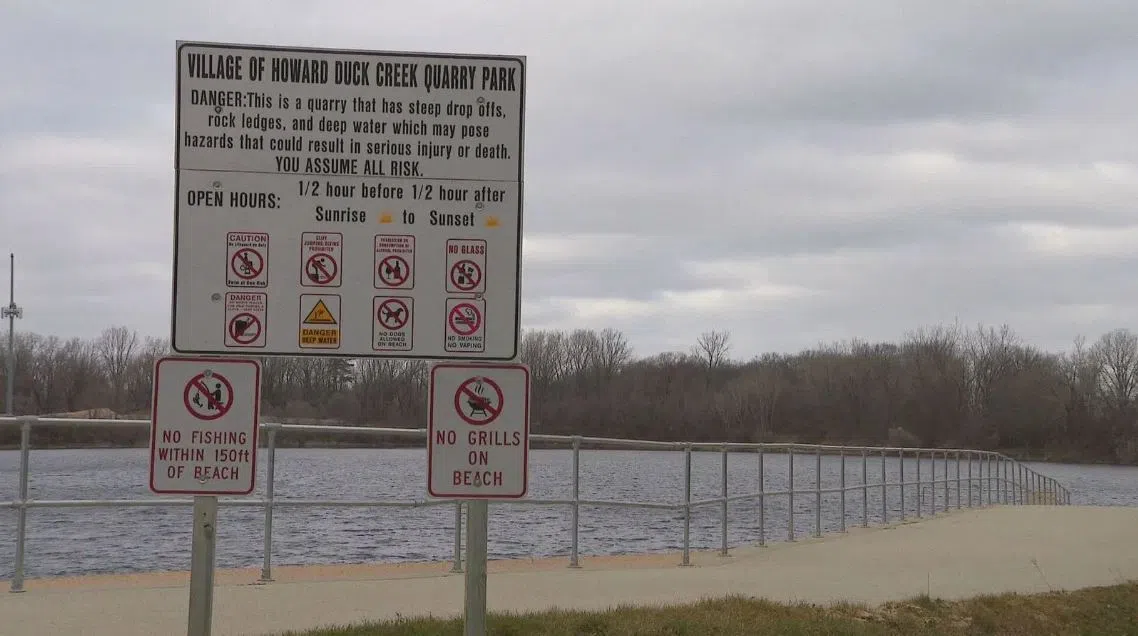
Some areas of Duck Creek Quarry in Howard are closed off to the public to prevent the possible spread of bird flu, December 18, 2023. PC: Fox 11 Online
HOWARD, WI (WTAQ-WLUK) – Preliminary lab results show the birds that have been sick and dying at Duck Creek Quarry have been a result of bird flu.
Wildlife officials say the issue isn’t new or confined to the quarry and colder temperatures would help slow the spread.
The dead bird count at the quarry is up to 45, according to animal control officer Matt Atkinson.
“It is slowing down a little bit,” said Atkinson. “After speaking with the DNR and kind of their thoughts, it sounds like it will probably slow down once we get the colder temperatures.”
The DNR says it is operating under the assumption any dead birds in the area likely had Highly Pathogenic Avian Influenza, or HPAI.
“We’ve gotten other reports from along the Fox River, the mouth of the Fox River,” said Steve Burns, a wildlife biologist for the DNR. “We’ve had some from Oneida Golf Club. So there’s been kind of little pockets around the Green Bay area.”
The bird flu is spread by bodily fluids.
Burns says the risk is low for humans and there’s been no indication of any animal to human transmission. Still, people are advised to use caution when dealing with any sick or dead animals.
“HPAI has been circulating in wild and domestic birds since like 2022,” said Burns. “That virus is just kind of in waterfowl and poultry all the time. It’s just when there’s a specific mutation to the virus, in this case, where it’s more deadly or causes more disease in the birds than typical.”
The Village of Howard closed the quarry and the trails for it three weeks ago, just after the first set of dead birds were discovered. To reopen, there will need to be five consecutive days of not finding any sick or dead birds.
“We’re hoping that before we open if we can find a way to do some sort of mass sanitation we will,” said Atkinson. “We’ll figure that out once we go five consecutive days.”
Until that happens, the village is encouraging people to stay away from the area.
Wildlife officials say transmission is typically seen during migration seasons, as well as in cool and damp weather.




Comments