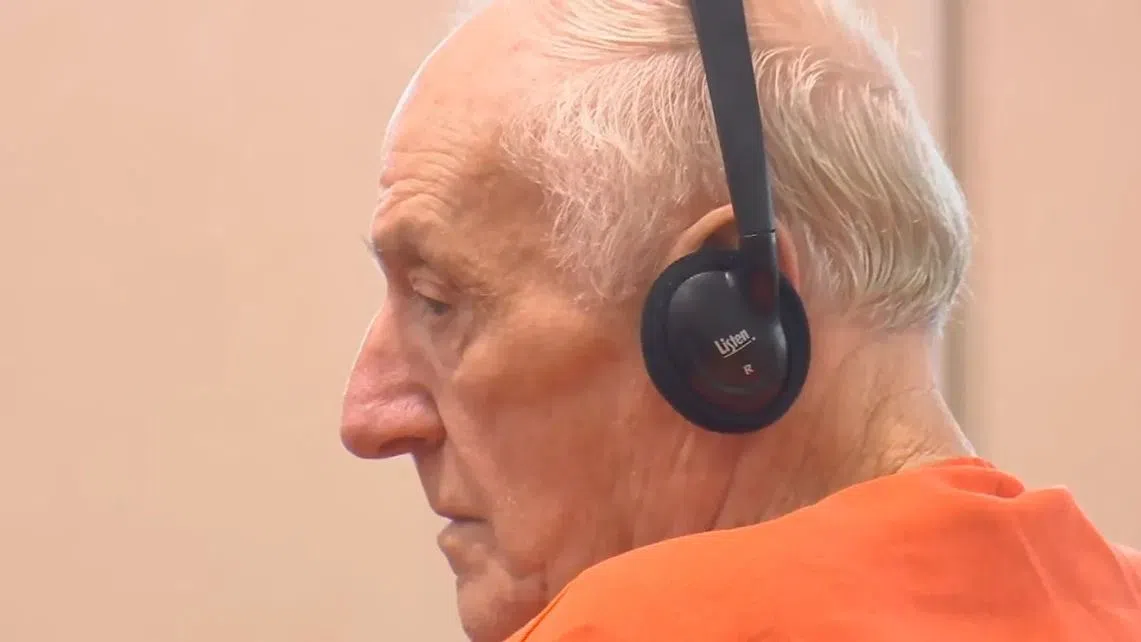
Raymand Vannieuwenhoven appears in Marinette County court Aug. 26, 2021, to be sentenced for the 1976 murders of David Schuldes and Ellen Matheys at McClintock Park. PC: Fox 11 Online
MARINETTE, WI (WTAQ-WLUK) — The ACLU says the Wisconsin Supreme Court should hear the case of a dead Marinette County man convicted for a 1976 double murder because of the deceptive tactics used by police to get key evidence in the case.
Ellen Mathys and David Schuldes were murdered at McClintock County Park in Marinette County in 1976. The case remained unsolved for more than four decades. In 2019, a DNA sample from evidence at the crime scene was determined to be from a particular family. After samples tested from Raymand Vannieuwenhoven’s brothers weren’t a match, a sample from him — obtained from a licked envelope for a phony survey on a police performance filled out by Raymand — was a match, according to the complaint.
Vannieuwenhoven went to trial, was convicted and was sentenced to consecutive life prison terms in the case. He died in 2022, while a resident at the long-term care unit at Oshkosh Correctional Institution — but the appeal continued as the defense sought a ruling to prevent similar police tactics in the future.
So far, the trial court and appeals court have both ruled the police tactics were legal. Now, attorneys are asking the Wisconsin Supreme Court to review the matter. The high court does not take every case asked of it; it decides which cases have issues of law which should be decided.
In a new filing, the American Civil Liberties Union field a ‘friend of the court’ brief, asking the high court to review Vannieuwenhoven’s case.
It argues there is a Constitutional issue at stake.
“When a police officer employs a ruse to get a person to touch or lick an item — like the envelope here — does the person relinquish their constitutional right to privacy in the genetic material involuntarily deposited on the item, even though they had no choice but to leave it there and notwithstanding the breadth of private information contained in their DNA?,” wrote attorney Emma Shakeshaft.
“Accepting the lower court’s logic would allow the State to create a database of every Wisconsinite’s DNA, without any court oversight, simply by blanketing households with surveys or other ruses, and extracting the DNA from each returned envelope or other item. That not only runs counter to recent state and federal constitutional decisions, but endangers the privacy rights of all Wisconsinites, and would disincentivize people from voluntarily engaging with government officials. This Court should grant review to correct those errors, and to answer the significant question of constitutional law this case poses,” she said.
Prosecutors oppose the motion, and believe the lower court rulings should stand.
There is no set timeline for the high court to decide if to take the case. If it does, additional briefs would be filed before oral arguments are scheduled. A decision would be issued months after that.




Comments