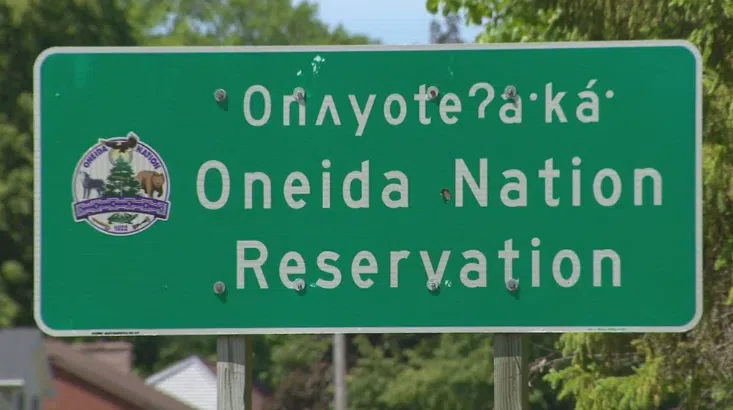
Oneida Nation Reservation sign. PC: Fox 11 Online
ONEIDA, WI (WTAQ-WLUK) — The Oneida Nation is touting its economic impact on Wisconsin.
According to a new study by St. Norbert College’s Center for Business & Economic Analysis, the nation generates more than $1 billion in economic activity in the state each year.
“The Oneida Nation is a substantial economic driver in the local, regional and state economy, and it was our goal to validate those contributions,” said Chairman Tehassi Hill in a news conference Wednesday. “[The study] provides data for our leadership to use in our decision-making and community education.”
The study showed the Oneida Nation supported 3,272 jobs, $179.2 million in income and $653.7 million in output. Total tribal operations were responsible for $983.8 million in output, $306 million in employee compensation and 5,409 jobs in Brown and Outagamie counties.
Kevin Quinn, dean of the School of Business and Economics at SNC, which houses the Center for Business & Economic Analysis, said the Oneida Nation has seen impressive economic growth since its last study was conducted.
“The college did this study some years back, and what we found was that there was a substantial increase — about $240 million — in additional economic activity from the 2018 study,” Quinn said.
He added the largest source of activity was gaming, with a direct impact of $249 million.
“It has a total impact of $324 million, so about a third of the impact is a result of the gaming. The gaming sector alone generates close to 1,500 jobs in Brown and Outagamie counties,” said Quinn.
Hill said that although he is proud of the nation’s economic achievements, there is still work to be done.
“We still have needs to be addressed in our community. Affordable housing, mental health, addiction, education, family services, poverty, law enforcement and clean air and water, just to name a few,” he said. “Thus, we are not done collaborating with local and state governments to leverage our economic power to mutually address these challenges in our communities.”




Comments