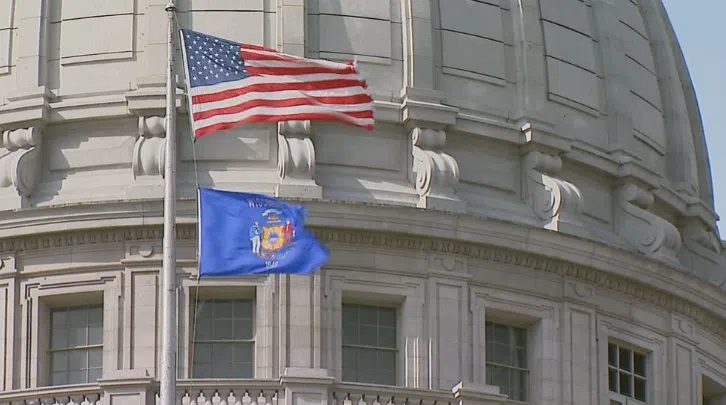
Wisconsin state capital in Madison. PC: Fox 11 Online
(WTAQ-WLUK) — Lawmakers are reacting to the failed budget surplus deal. It would have provided relief to taxpayers, funding for public schools and eliminating state tax on tips and overtime pay.
The Wisconsin State senate rejected the bill late Wednesday night.
In an unusual twist, Wisconsin senate Democrats turned their back against Governor Tony Evers.
Three Republicans joined Democrats in the no vote to push it over the line.
Republican candidate for Governor Tom Tiffany reportedly asked some senate Republicans to vote against the measure.
Evers released a statement which reads in part:
Wisconsin’s kids and schools aren’t going to get the investments they desperately need this year because Tom Tiffany and a few Republican and Democratic lawmakers chose to blow up a bipartisan plan to invest in our K-12 schools, lower property taxes, and help working families afford rising costs, all because they’d rather do what’s best for the next election than what’s right for the people of our state.
State Sen. Jamie Wall, D-Green Bay, is one of the many Democrats who voted against the bill.
“So it didn’t seem wise to me to absolutely empty the checkbook when we might be headed into a downturn,” Wall said.
Wall said passing the deal would have created a nearly $3 billion gap in the next state budget.
He attributed that figure to the Legislative Fiscal Bureau.
However, Evers said on Tuesday that it’s unlikely that projection is accurate and wouldn’t create a deficit.
While Wall liked most ideas in the proposal, he called it simply unaffordable.
“I took a step back and looked at that pile and said the state can’t afford that. No business would run its finances like this and neither should the state,” Wall said.
Many Republicans, meanwhile, are frustrated the bill failed.
“I think it’s the first time I’ve ever heard my Democratic colleagues worried about the structural deficit because usually they’re the ones proposing that blow a huge hole through it and certainly their additional spending would do that,” State Sen. Andre Jacque, R-New Franken, said.
Jacque said he’s concerned about how Wisconsinites will be impacted by the vote.
The bill would have provided $850 million in direct payments to taxpayers and $617 million to schools– half of that was set aside for special ed reimbursements.
As for what’s next, it’s likely we will hear a lot about Wednesday’s votes during upcoming midterm campaigns.




Comments