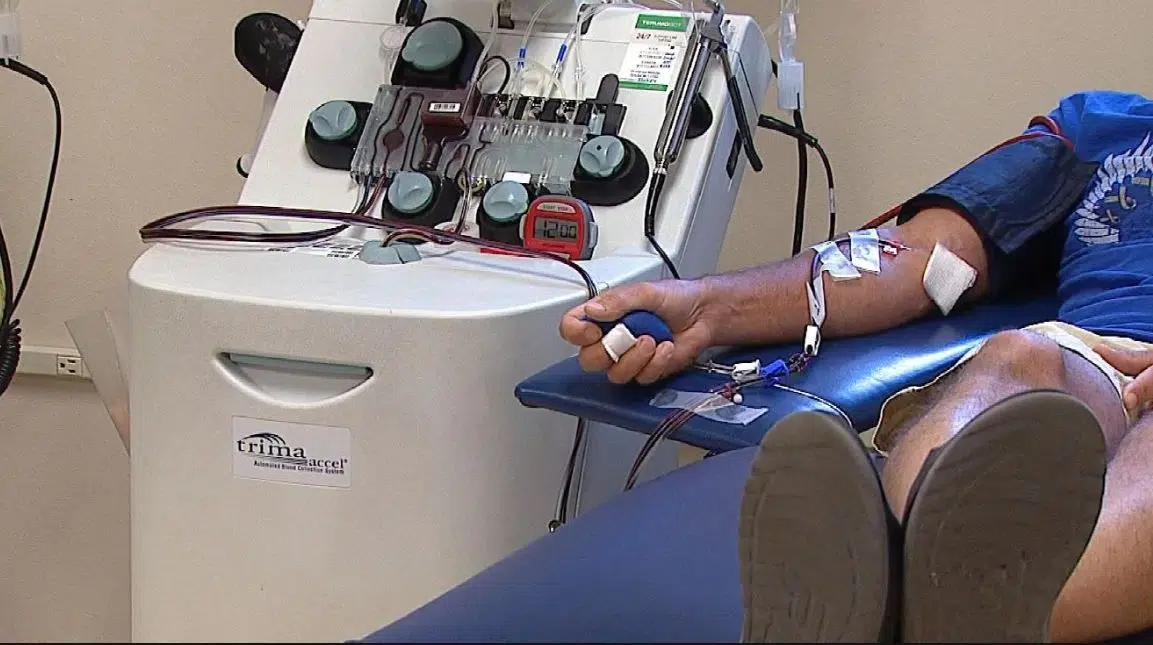
Donation at Community Blood Center on August 29, 2016. PC: Fox 11 Online
APPLETON, WI (WTAQ-WLUK) — U.S. Rep. Tony Wied, R-8th District, is efforting legislation that he hopes will encourage more blood donations and avoid periods of critical shortages.
The winter months are always a bit slower at blood donation centers, officials say.
“We’ve got holidays. People are busy doing other things in the winter months. The cold weather, things get canceled. People don’t want to go out in the cold. But patients can’t wait. We really need people to come in,” says Tricia Voskuil, vice president of sales and marketing for the Community Blood Center.
Voskuil say right now, all blood types and platelets are much needed.
“Right now, Os are really in high demand,” she says. “We’re at about a two-and-a-half-day supply, which isn’t enough for us to continue to move forward if there’s a big accident or some other big need.”
While blood is a necessity all the time, she says there’s never really a “comfortable” supply amount, but they feel safer when they have at least a five-to-seven-day supply.
As a way to combat this growing issue, Wied — alongside U.S. Rep. Kim Schrier, D-Washington — introduced the Blood Centers Act.
“The Blood Centers Act really is a way to decrease the amount of regulations that it requires for donation centers to open up new locations,” he says. “Really cutting the red tape, allowing for blood centers to expand more easily.”
At a time when it’s already hard to get donors through the doors, does opening up more centers help? The Community Blood Center says yes.
“The more blood donation centers and mobile drives that we have, then we can cater to the public. We can cater to what makes it easier for them to donate blood,” Voskuil stresses.
Wied says the Blood Centers Act is especially helpful for places like the Community Blood Center — locations that are well established and successful, allowing them to grow more quickly and increase impact.
“People may struggle with transportation and things like that if it’s farther away, so the closer you can get these blood centers to people, the more opportunities there are for people,” Wied adds. “Again, blood is at a critical low right now, and it is obviously needed, and I just want to be helpful and certainly raise awareness in my role as the representative of Northeastern Wisconsin and in this country, to again, increase the blood supply.”
With impending winter weather both here and in the southern United States, some of the blood donated in our community may be shipped out to help other communities that are struggling. That means the need for blood and platelets is even higher right now.
“If you’re a high schooler or an educator, and maybe your work’s been canceled or you get to work remotely [Friday], consider taking an hour and coming in to donate blood. We’re here, and we could really use the blood in platelets. It truly is a life-saving thing,” Voskuil says.
Blood donations can live on the shelves for 42 days, Voskuil adds, but platelets only have a five-to-seven-day shelf life, which makes the need for them higher. Community Blood Center officials say the process for donating platelets is the same as donating blood; it just takes a few extra minutes.
The Community Blood Center also has a rewards program to help incentivize more blood and platelet donations.
“For every basically two-and-a-half times a blood donor comes in, they will have received a $25 gift card, and platelet donors, every about one-and-a-half times that they come in, they’ll receive a $25 gratitude gift,” she says.
Information about giving blood or scheduling your donation can be found here.




Comments