PHOTO: Courtesy of WLUK
(WTAQ-WLUK) — This year’s record breaking summer travel season will come to an end this weekend for Labor Day.
AAA reports domestic travel over Labor Day weekend is expected to be up 9% compared to last year.
If you plan to travel by car, it will be a little cheaper than last year.
The national average over Labor Day weekend in 2023 was $3.81. In recent weeks, gas prices have remained steady, hovering around $3.50.
The busiest times for travel expected this weekend are:
- Thursday (Aug. 29): 1 p.m. to 7:30 p.m.
- Friday (Aug. 30): 2 p.m. to 6 p.m.
- Saturday (Aug. 31): Morning hours
- Sunday (Sept. 1): Afternoon hours
- Monday (Sept. 2): 11 a.m. to 8 p.m.
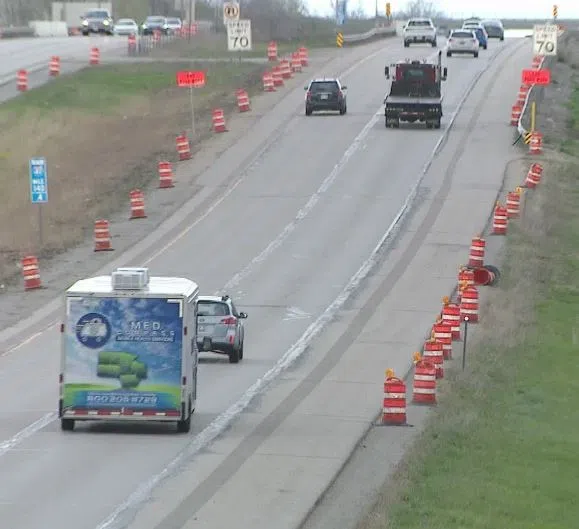
Also before hitting the road, drivers should be aware of some ongoing road projects. While the WisDOT is temporarily pausing most construction projects over Labor Day weekend, these areas will still affect traffic.
Northeast Wisconsin road projects:
- Outagamie and Winnebago counties: Northbound I-41 is reduced to two lanes between Main Street and US 10/WIS 441 in the Fox Valley area. Significant delays are expected and drivers should consider alternate routes. Watch for lane shifts and reduced speed limits.
- Outagamie County: Be alert for nighttime (9 p.m. to 5 a.m.) lane closures on I-41 between Appleton and Kaukauna. All ramps are closed at the I-41 and County N interchange in Kaukauna.
- Outagamie County: WIS 15 is closed to through traffic between US 45 in the city of New London and County T in the village of Hortonville. Traffic is detoured via US 45, County TT and County T.
- Winnebago County: I-41 is reduced to two lanes in each direction over the Lake Butte Des Morts bridge near Oshkosh. The southbound US 45 ramp to southbound I-41 is also closed. Watch for lane shifts and reduced speeds.
For a full list of projects around the state, click here.
For real-time information on travel conditions, live traffic cameras, work zones and incidents across Wisconsin:
- Download the free 511 Wisconsin app
- Visit 511wi.gov
- Follow @511WI on X
- Dial 511
Alerts and updates provided via these sites are not intended for use while driving. When driving, your focus should always be on the road ahead.
WisDOT offers these additional safety reminders:
- Buckle Up, Phone Down – every trip, every time. Encourage family, friends and co-workers to take the pledge.
- Slow down. Posted speed limits apply to ideal travel conditions. Drivers are required to travel at a “reasonable and prudent” speed based on weather and traffic conditions.
- Eliminate distractions and focus on what’s ahead. Texting while driving is prohibited and very dangerous. It is also illegal in Wisconsin for drivers to use a handheld mobile device in work zones.
- Move over or slow down for emergency responders stopped along a highway with their warning lights flashing. That includes police and fire vehicles, ambulances, tow trucks and highway maintenance vehicles. In addition, state law restricts use of a cell phone in areas surrounding those vehicles.
- Steer It, Clear It! State law requires drivers to move vehicles involved in a crash out of traffic if no one is hurt and the vehicles can be moved safely. If someone is hurt or the vehicle is disabled, drivers should not risk injury by trying to push the vehicle out of traffic.
And if you plan on drinking alcohol, make sure you have sober driver plan made beforehand. Law enforcement agencies across Wisconsin are participating in the Drive Sober or Get Pulled Over campaign through Labor Day. Extra patrols will be dedicated to focus on impaired drivers.
And the same goes for boating.
“Alcohol use and poor decision-making are the two biggest contributing factors that lead to boating-related incidents,” said Lt. Darren Kuhn, DNR boating law administrator. “Alcohol affects people very differently on the water than on dry ground. The constant exposure to sun, waves, wind and all other environmental factors increase the speed at which alcohol affects somebody while on the boat.”
The Wisconsin Department of Natural Resources (DNR) is also reminding the public to wear a life jacket.
There have been 13 boating-related fatalities so far this boating season, nine of which were confirmed not to be wearing life jackets. The law requires one wearable and correctly sized life jacket be readily available for each person aboard.
State law requires all people born after Jan. 1, 1989, to take a boater education course before they are legally able to operate a motorboat.
Other DNR boat safety tips:
- Slow down at night.
- Check your navigation lights before the sun goes down. All motorboats are required to have red/green navigation lights and white all-around lights when operating after sunset.
- Slow down if visibility is an issue or boating on unfamiliar waterways.
- Keep an eye on the weather and let someone know where you are going.




Comments