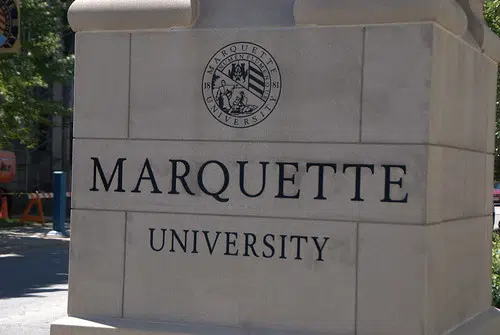
MILWAUKEE, WI (WTAQ) — Why were the polls so wrong? That’s a question a lot of people are asking as the election results pour in.
While the number of Republican votes may not be enough to win President Donald Trump a second term in the White House, they still shocked national media talking heads and Democratic Party operatives looking for an overwhelming rejection of the Trump Presidency. Joe Biden holds a slim lead in the battleground states he’s won, and if he wins states that have yet to be announced, those leads are sure to be even slimmer.
“There are pretty substantial systematic errors in the polls across a number of these battleground states,” Marquette University Law School Poll director Charles Franklin told WTAQ. “More widespread issues than in 2016.”
Polling prior to the election in Wisconsin had Biden winning by as many as 10 to 17 points, depending on the poll you were looking at. The Marquette University Law School Poll, one of the most visible Wisconsin polls in the country, had Biden winning by around four or five points, depending on turnout.
“Our average error is about two points, so being off by three or four is a bit bigger than that,” Franklin said Thursday. “So many pollsters were off by seven, eight, nine points, and that is a bigger concern for the polling industry.”
So it loops back to the question at hand: why were the polls so wrong? Franklin says that isn’t an easy question to answer.
“The cluster of polls that was averaging eight to 11 [points off]…I think they need to reassess how they were monitoring the electorate and how they were drawing their samples,” explained Franklin.
He says those polls may not have been factoring in an emerging swath of mostly Trump-supporting voters who are reluctant to agree to interviews with pollsters via phone.
“Some, not a lot, but some Trump supporters may be more likely to decline to do an interview in comparison to other Republicans,” said Franklin.
Polls may have also failed to account for turnout in different areas throughout the state.
Of particular interest to pollsters is the national popular vote count. While it has no bearing whatsoever on who wins the White House, the final vote tally will determine whether or not there was also a large national polling error.
Lawrence University Professor Arnold Shober told WTAQ’s ‘The Morning News with Matt and Earl’ on Wednesday that he anticipates polls will get considerably less media attention in 2024 as a result of the polling errors seen this year, as well as those in 2016.




Comments