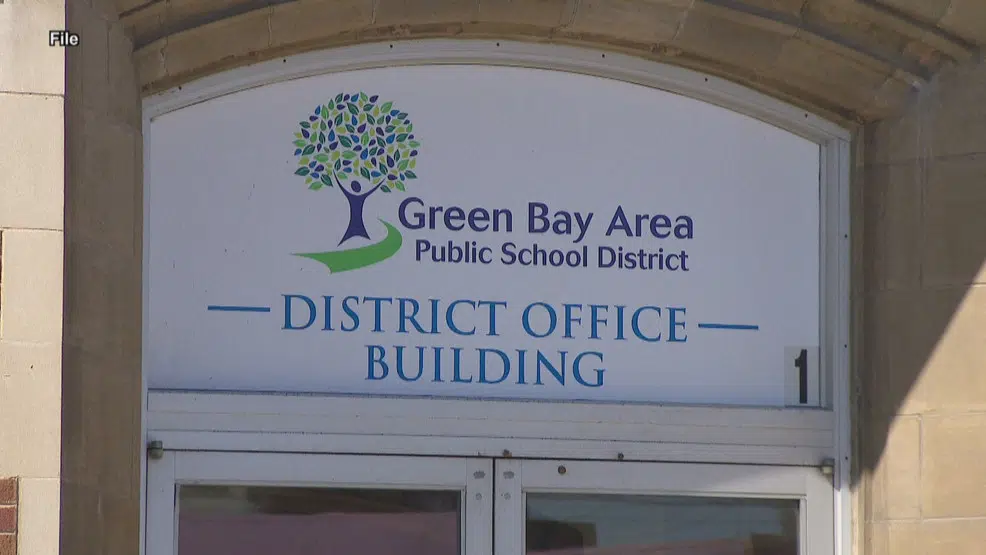
Green Bay Area Public School District building. (IMAGE: Courtesy of Fox 11 WLUK)
GREEN BAY, WI (WTAQ-WLUK) – With the seventh week of virtual learning underway in Green Bay, the school board has adopted gating criteria to help guide the transition back to on-site learning.
That criteria requires community percentages of COVID-19 to be less than 100 out of 100,000 for two consecutive weeks. It also follows CDC guidance on five risk transmission factor levels.
“We would be in an on site with all students present in the lowest in lower, and then we would be in a blended model in the moderate and also a portion of the higher risk category,” said Superintendent Stephen Murley. “The top end of the higher risk and the highest risk categories would find us in the offsite model.”
However, Murley says the community has so much spread that it’s simply not safe to send kids and teachers back at this point. Even teachers are starting to see some struggles as they were recently forced to work from home.
“Obviously, many of us prefer to work in our classrooms. We have all of our materials and resources, it’s a space dedicated to work, there’s a high comfort factor being there. Transitioning to an alternate work site is always a challenge,” Murley said. “Our teachers are are doing while they’re adapting to that and what it does is it allows us to make sure that the essential functions of the district can continue.”
Schools are still providing lunches for students. Families are able to go to their regular school sites for meal distribution, which has been moved outside to prevent the movement of people in and out of buildings.
Some parents continue to raise questions about the progress of students this year, and whether they are actually on-track with where they should be at this point in the semester. Murley says while the online environment obviously isn’t the same as being in a physical classroom with a teacher – challenges are expected, and adjustments are being made.
“We use formative assessments that help us benchmark student progress so we understand how quickly they’re moving through the curriculum. We’ve tried to eliminate some of our assessments, we just understand it’s a challenge for kids and families in this non-standard teaching environment,” Murley explained. “That does, then, provide us a less data. So it’s a little bit harder for us to know exactly how on track our kids are right now.”
The district is approaching a marking period as well, which Murley says will provide an opportunity to review their current strategies and make some changes and transitions to better serve students.
As for technology issues, Murley says they’re seeing a downward trend in major complications as IT crews have been working with everyone to ensure better connections.
“As they work with students and families and as they work with teachers, there’s much more consistency out there. People are unfortunately settling into this new normal, and that number of technology challenges has gone down substantially,” Murley said.
Other staff also remains available as the mental health concerns grow for students and teachers alike.
“[We have] people on staff whose job it is to help students process through this. Whether it’s school counselors, social workers, school psychologists – they provide that type of support for students and their families,” Murley said. “Calls to the employee assistance program are up dramatically this year. So we know that our staff are under a great deal of stress right now, and it’s not just the teaching learning component of their jobs but also what’s going on in their outside lives and what’s going on in the community.”




Comments