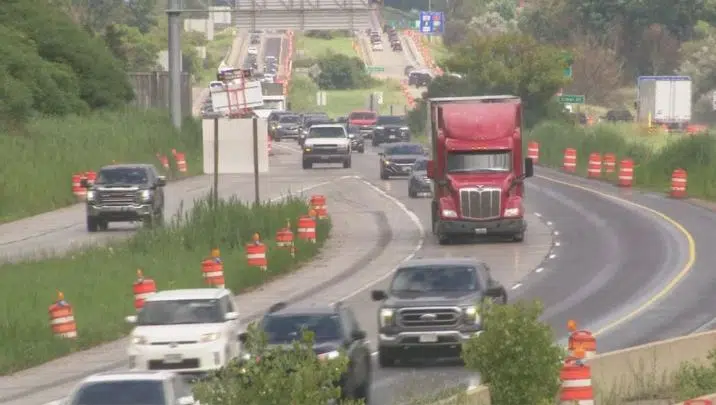
Vehicles travel on Highway 172 in Brown County on July 20, 2023. PC: Fox 11 Online
GREEN BAY, WI (WTAQ) — State and federal transportation funding increases have allowed Wisconsin to move forward with projects to improve the condition, reliability and safety of the state’s transportation system.
Despite these funding increases, Wisconsin still faces challenges in improving and maintaining its transportation system to improve traffic safety, relieve traffic congestion, and improve road and bridge conditions.
Roads and bridges that are deteriorated, congested, or lack some desirable safety features cost Wisconsin motorists a total of $7.6 billion statewide annually – $1,596 per driver in the Green Bay-Appleton-Oshkosh area – due to higher vehicle operating costs, traffic crashes and congestion-related delays.
Increased investment in transportation improvements at the local, state and federal levels could relieve traffic congestion, improve road, bridge and transit conditions, boost safety, and support long-term economic growth in Wisconsin, according to a new report released Tuesday by TRIP, a Washington, DC based national transportation research nonprofit.
The TRIP report, “Keeping Wisconsin Mobile: Providing a Modern, Sustainable Transportation System in the Badger State,” finds that throughout Wisconsin, nearly half of major locally and state-maintained roads are in poor or mediocre condition, seven percent of locally and state-maintained bridges (20 feet or more in length) are rated poor/structurally deficient, and 2,967 people lost their lives on the state’s roads from 2018-2022. In the Green Bay-Appleton-Oshkosh area, 40 people lost their lives annually on the roads between 2018-2022.
Wisconsin’ major urban roads are congested, causing significant delays and choking commuting and commerce. Driving on roads in the Green Bay-Appleton-Oshkosh urban area costs the average driver $1,596 per year in the form of extra vehicle operating costs (VOC) as a result of driving on roads in need of repair, lost time, and fuel due to congestion-related delays. The costs of traffic crashes in which the lack of adequate roadway safety features, while not the primary factor, likely were a contributing factor.
Traffic congestion in the Green Bay-Appleton-Oshkosh urban area causes 15 annual hours of delay for the average motorist and costs the average driver $389 annually in lost time and wasted fuel. Green Bay-Appleton-Oshkosh drivers waste an average of seven gallons of fuel per year as a result of traffic congestion. Statewide, drivers lose $1.9 billion annually as a result of lost time and wasted fuel due to traffic congestion.
The TRIP report finds that 43 percent of major locally and state-maintained roads in the Green Bay-Appleton-Oshkosh urban area are in poor condition and another 24 percent are in mediocre condition, costing the average motorist an additional $909 each year in extra vehicle operating costs, including accelerated vehicle depreciation, additional repair costs, and increased fuel consumption and tire wear. Statewide, 25 percent of Wisconsin’ major roads are in poor condition and 20 percent are in mediocre condition.
In the Green Bay-Appleton-Oshkosh urban area, four percent of bridges are rated poor/structurally deficient, with significant deterioration to the bridge deck, supports, or other major components. Statewide, seven percent of Wisconsin’ bridges are rated poor/structurally deficient.
The TRIP report includes additional statewide and regional pavement and bridge conditions, congestion data, highway safety data, and cost breakdowns for the Eau Claire, Green Bay-Appleton-Oshkosh, Kenosha, Madison, Milwaukee and Wausau areas.




Comments