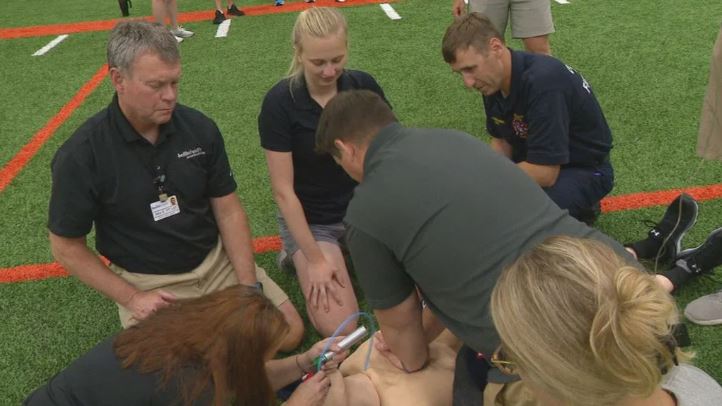
Bellin Health licensed athletic trainers practice emergency scenarios. PC: Fox 11 Online
DE PERE, WI (WTAQ-WLUK) — Summer may be in full swing, but some Bellin Health athletic trainers are preparing for fall and the rest of the high school sports seasons.
It was the collision witnessed around the world. The Buffalo Bill’s Damar Hamlin went into cardiac arrest following a hit on Monday Night Football earlier this year.
An athletic trainer credited with giving him CPR, helping to save his life.
While injuries like Hamlin’s are rare, there are plenty of other incidents on the field and in the gym that lead to serious injuries for athletes.
“Everything from catastrophic injury, dislocations and fractures to cardiac events to head trauma and everything else,” says Roland Schmidt, a licensed athletic trainer with Bellin Sports Medicine.
Those are just some of the things these Bellin Health Sports Medicine athletic trainers could see when they work with teams and athletes, in the more than 30 school districts across Wisconsin and the Upper Peninsula of Michigan, the healthcare provider partners with.
Being prepared for those scenarios is what led Bellin Sports Medicine to host this training for its athletic training staff.
According to Schmidt, “Your body really can’t go where your mind hasn’t been. And if you haven’t practiced these scenarios or thought about these scenarios you really can’t participate or practice these scenarios quickly in an emergency situation.”
Bellin Health is teaming up with Sports Medicine Concepts, a company out of New York that works with professional sports leagues, to run its athletic trainers through different scenarios.
“We aren’t here to teach because we believe the athletic programs out there are very good. What we’re trying to do is get them to think of things that are different. How do I communicate with EMS, how do I work with the coaches, do I have the right equipment, is there something we can do better to improve, to make sure when our athletes do get hurt they have the best care possible,” says Chris Stiegler with SMC.
Everything from an athlete in cardiac arrest, to an open, lower leg fracture with intense bleeding. The athletic trainers were not only running through the scenarios and treatment, but they were also cognizant of the people and potential helpers around them or those coming to help.
“The ah-ha moment is just communication. It’s so important, especially when EMS comes, all the questions they were asking on the phone,” says licensed athletic trainer Allison Pahl. She adds, “Knowing their role and seeing that side of it definitely makes me better prepared and how I can help them should I need them to come on to an emergency situation.”
Because at the end of the day or the game it’s all about taking care of the patient/player/athlete the best way they know how.




Comments