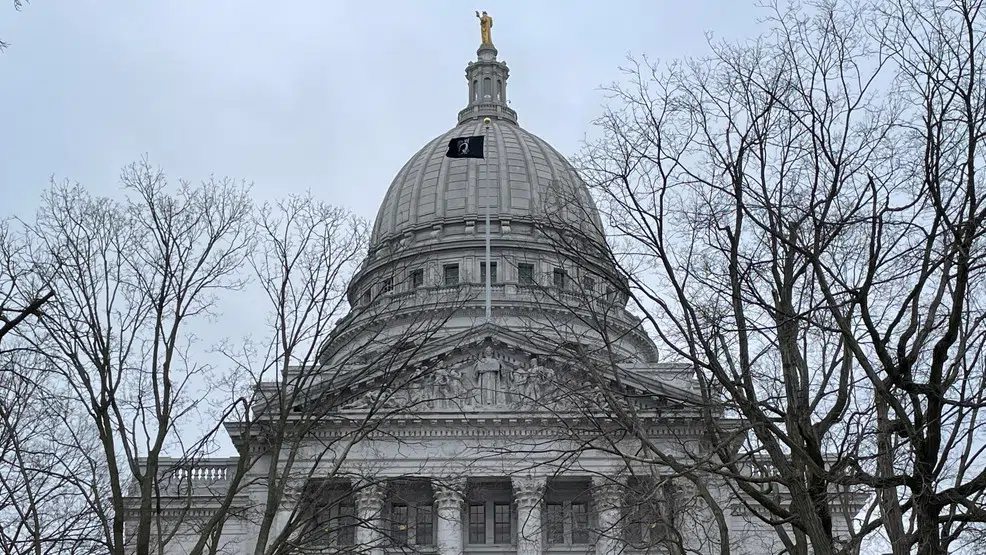
The exterior dome of the Wisconsin state Capitol is seen in Madison Feb. 15, 2023. PC: Fox 11 Online
MADISON, WI (WTAQ-WLUK) — Gov. Tony Evers took action on two bills that impact worker’s compensation and unemployment insurance.
Evers’ office says Act 145 was negotiated with the Worker’s Compensation Advisory Council. According to the governor’s office, the newly signed bill:
Reflects recommendations of the Worker’s Compensation Advisory Council and is intended to make incremental adjustments to benefit adequacy, system efficiency, and program integrity, including:
-Increasing the maximum weekly compensation rate;
-Expanding eligibility for supplemental benefits in cases of permanent total disability due to a workplace injury;
-Allowing lump-sum payments to be made directly to injured employees, if requirements are met;
-Modifying the statutes of limitation, establishing no statute of limitation for traumatic injuries requiring shoulder replacement or reverse shoulder replacement;
-Expanding worker’s compensation coverage for PTSD by extending eligibility to emergency medical responders, emergency medical services practitioners, and volunteer or part-time firefighters under standards and limitations similar to those applicable to law enforcement officers and full-time firefighters;
-Strengthening enforcement provisions by increasing penalties for employers who fail to maintain required worker’s compensation insurance, and by creating or expanding criminal penalties related to fraudulent applications and misclassification of employees to reduce premiums;
-Prohibiting the “stacking” of permanent partial disability ratings for repeated surgical procedures on the same limb and provides that healthcare providers shall determine a permanent disability rating;
-Allowing an employer’s or insurer’s case management personnel to access records and participation in discharge planning when required to ensure that the employee with a disability has appropriate housing and transportation in the case of an inpatient hospitalization of an employee;
-Making multiple changes to hearing and dispute resolution procedures; and
-Requiring insurance carriers to file claims electronically or in the media format required by the department.
Meanwhile, Evers partially vetoed a separate bill impacting the state’s unemployment insurance program.
Evers says the bill allows funds for drug testing to also be used to verify a claimant’s identity. The bill increases funding for worker’s compensation administration and requires certain insurance costs to be paid from the uninsured employers fund, not the worker’s compensation general fund.
Evers vetoed the section regarding identity verification, saying it refers to a statue which does not exist.
“While safeguarding the identity of the unemployment insurance system is important, I object to including this restriction on funding purpose to activities under a non-existent statute,” Evers wrote in his veto message. “Further, current law already provides the department with tools to verify identity and prevent fraud, and the department conducts a variety of anti-fraud activities.”
Wisconsin has been working to modernize its unemployment insurance system since the COVID-19 pandemic exposed shortcomings.




Comments