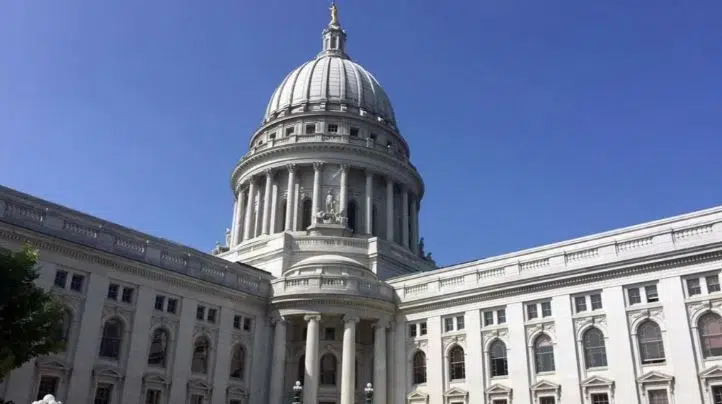
The Wisconsin State Capitol dome in Madison. PC: Fox 11 Online
(WTAQ-WLUK) — After last year’s record-shattering Wisconsin Supreme Court race between Susan Crawford and Brad Schimel, some state legislators are hoping to avoid seeing that much big money involved in judicial races in the future.
It comes as Wisconsin is six weeks away from its next state Supreme Court election between Chris Taylor and Maria Lazar, which hasn’t garnered nearly as much attention, interest or money.
“Many people ask for us to get back to the way things used to be. To do that, we have to get the money out of politics. That’s the bottom line. We should all agree on that,” said Democratic State Sen. Kristin Dassler-Alfheim of Appleton.
Dassler-Alfheim is one of the co-authors of a new bill that would re-establish publicly-funded elections for judicial candidates in Wisconsin, including judges seeking to join the state’s highest court.
For appeals judges and circuit court judges, the new bill would grant each candidate $100,000 in the spring primary and $300,000 in the spring election. For Supreme Court judges, those numbers jump to $1 million and $3 million, respectively.
That money would be generated by the taxpayers, who can opt to allocate $5 of their tax refund to the candidates’ money pool, which will then be split between the two candidates.
The bill would also be voluntary for the candidates. Both would have to agree to accept the public dollars. The alternative is what they do now: raising money on their own, which oftentimes includes accepting higher dollar amounts from individuals. That would not be allowed under this new legislation.
“I’ve yet to meet anyone who is excited about the TV ads and the mailers and everything else,” said Dassler-Alfheim. “And this is not a perfect bill, but it is the beginning of a conversation to say, ‘Can we have a better way? Can we, as elected officials, agree to limit ourselves and not take the outside dollars?'”
Those outside dollars from third-party political groups, PACs, super PACs and mega donors are really where the issue of big money in politics lies.
“The two most expensive state Supreme Court races in the history of our country were in Wisconsin in the previous two years,” said Mark Graul, a Republican operative and campaign strategist. “And I think there’s a reason to be concerned about that kind of money in your judicial election, and what judicial elections in Wisconsin have become.”
Graul worries a bill like this could unintentionally have the opposite effect that lawmakers are going for.
“You still have the problem, as the United States Supreme Court has said, that campaigns or outside organizations are free to express themselves in political campaigns in a way that would drown out, frankly, candidates’ campaigns themselves, and candidates even with a $3 million budget,” he said.
It’s not a bad idea, but the problem really lies with those third parties that can’t be controlled and can’t be capital-limited. It’s very good intentions, and I think something that helps bring more focus to what these judicial ratios look like, but ultimately, controlling political speech has become very difficult, based on some of the U.S. court rulings on that.
Dassler-Alfheim knows this bill doesn’t solve it all.
“I think the public is begging for us to start taking action again,” she said. “This bill will not solve everything, but at least… we agree that this money has gotten out of control, and let’s get back to the basics of selecting our candidates based on skill set and talent and their integrity,” she said.
She says this bill is the first step — essentially an agreement on all sides that big money in politics is an issue. The next step, she says, would be looking at what the state can do to further minimize those third-party groups.
So far, the Republican-backed candidate, Maria Lazar, has raised around $400,000 since joining the race in October. The Democratic-backed candidate, Chris Taylor, has raised $3.4 million since entering in early 2025. That means Taylor has outraised the $3 million amount a publicly-funded option would grant.



Comments