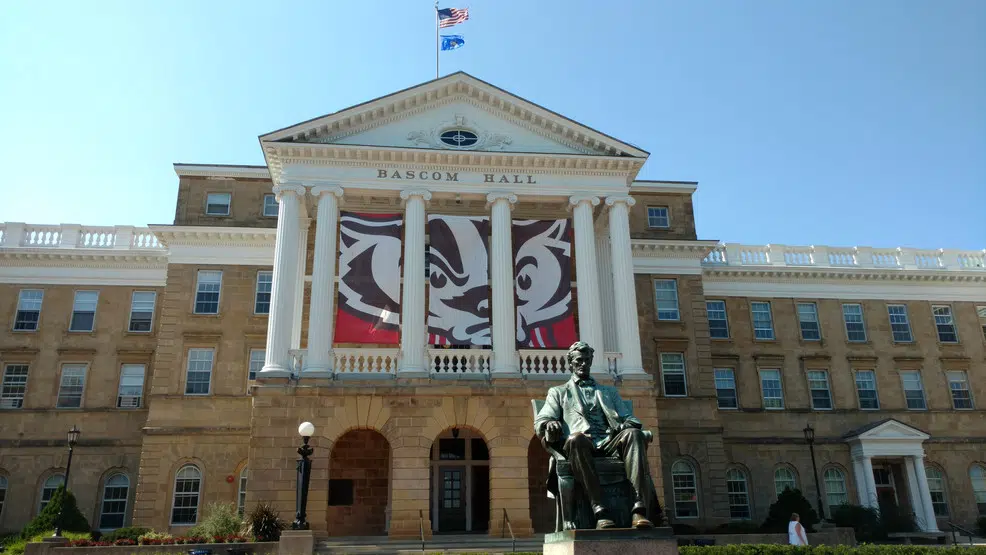
The Lincoln statue at the UW Madison Campus (Fox 11 Online)
(WTAQ-WLUK) — John Hall, an expert in U.S. military history and policy at the University of Wisconsin-Madison, said he wasn’t surprised when he heard the United States had launched strikes against Iran.
Jason Brozek, a professor of international affairs and associate professor of government at Lawrence University in Appleton, also saw it coming.
“I wasn’t surprised, because the build-up has been so public. In many ways, this has almost been an inevitable step for the Trump administration to take,” Brozek said.
Hall added, “The scale of the attacks — more or less, launching a major campaign designed to completely cripple the regime — did strike me as something of a surprise.”
Why was that a surprise?
Hall cited previous strikes by the Trump administration, like the killing of military officer Qasem Soleimani in 2020 and Operation Midnight Hammer in 2025. He called those more limited strikes that “have explicit targets and produce finite ends.”
“This is an assault which does not really produce any kind of desired action from the Iranian regime, because it is designed quite evidently to cripple destroy and topple that regime,” said Hall.
Hall said the main goal of any regime is to stay in power. Now that the Iranians are facing a threat, he described this as a problem for all parties.
“The administration has not provided them with an off-ramp, and so at this point, the regime’s claim to power really has very little incentive to hold anything back,” said Hall.
He pointed to Iran’s recent drone and missile strikes on neighboring Gulf states that weren’t involved with the U.S.-Israeli attack as a clear escalation — something Hall says could go further.
“At this point, they have not undertaken the full range of responses available to them. That includes overseas acts of terror to include acts of terror against the United States homeland,” he said.
Concern about Iran’s potential nuclear capability has been at the center of the conflict.
Brozek touched on that in his responses, saying, “President Trump’s justification is about threats to the U.S. and allies, but most of those threats seem to be vapor. The Iranian regime is no friend of the U.S., for sure, but there’s no evidence they were anywhere close to a nuclear missile that could strike the U.S., despite Trump’s claims to the contrary.”
President Trump hasn’t committed to anything regarding sending troops into Iran.
“I do not see that as a possibility. I think this administration has made very clear, what I believe, to be a sincere aversion to those kinds of deployments. That’s not just with the president, but also with senior members of his Cabinet,” said Hall.
Brozek agreed, saying, “I would be shocked to see boots on the ground, given recent U.S. military actions around the world. It’s just something that the American public has not been willing to do.”
However, Hall specifically noted, “There are American boots on the ground. There are American boots in Kuwait. This is where U.S. service members have been killed. There are American soldiers in Iraq. There are American service members all throughout the Gulf, and they are in fact, in harm’s way right now. But in terms of an actual occupation force, I do not see that as likely.”
What comes next? Trump suggested Iran could become a democracy or republic, which Hall believes is highly unlikely.
“The Iranian Revolutionary Guards Corps may decide that the preservation of the Iranian state requires them to seize the reins of power,” said Hall.
If that were to happen, Hall added the IRGC would likely open a line of communication to the West and try to come to an agreement with the Trump administration.
Both Hall and Brozek said we will likely see a new Iranian leader emerge in the near future. However, that won’t necessarily be a permanent successor.




Comments