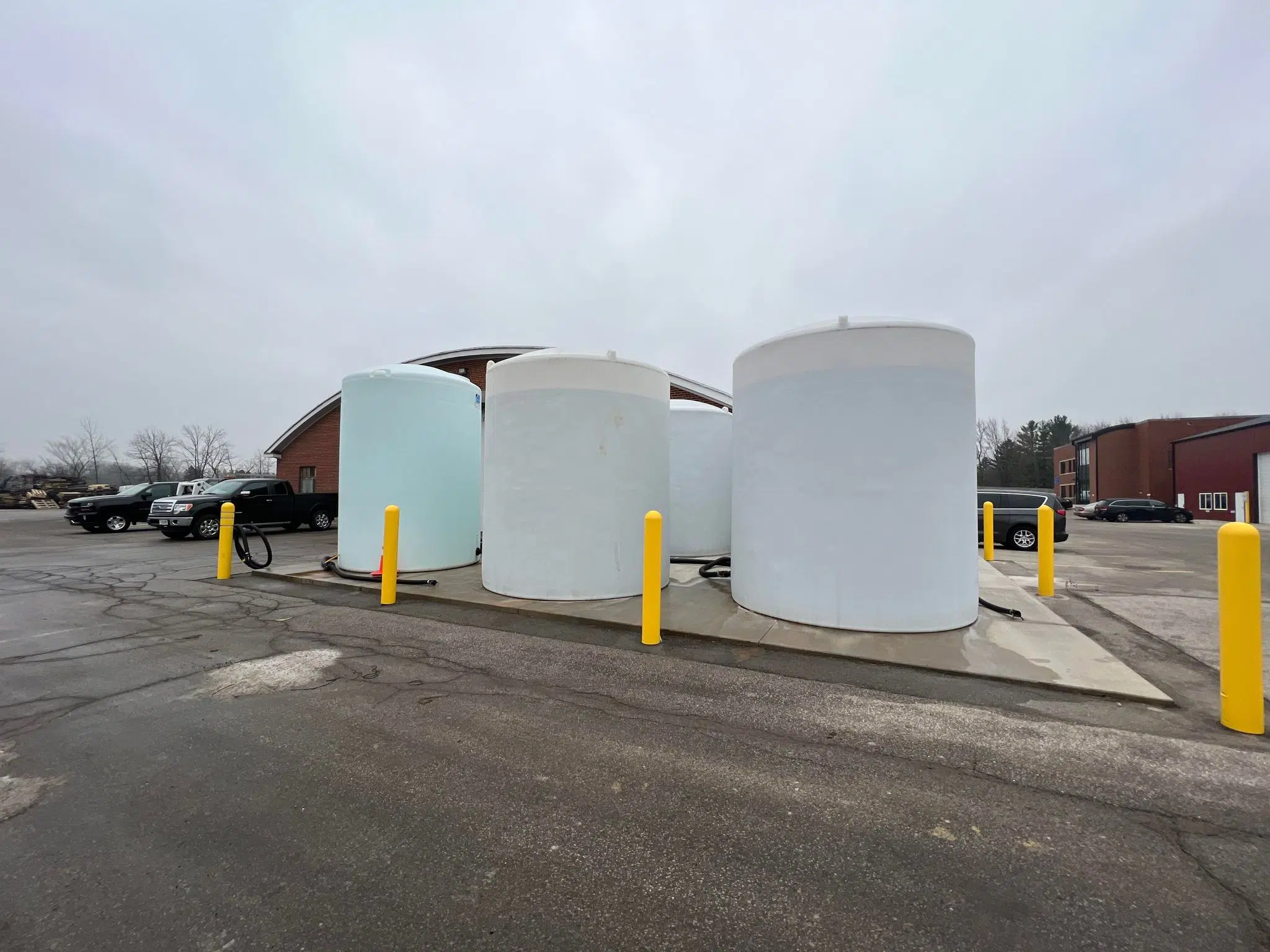
Brine Tank at Brown County Highway Department
(WTAQ-WLUK) — Using brine on roads ahead of wintry weather is one of the most visible ways road treatment has changed over the years.
A new study shows how effective that same brine is when applied directly on top of snow and ice.
They’re ubiquitous in the winter months these days: white lines of dried brine appearing on roads any time wintry weather appears in the forecast, helping keep roads passable. This pre-treating isn’t anything new — and it already saves on salt usage.
But now, the Wisconsin Department of Transportation has new data on how that same brine might work if applied directly to snow once it falls, as opposed to granular salt. They focused in on real-world driving impacts.
“With this study, what we would like to show to the traveling public is the benefits of the brine that is directly affecting their day-to-day travel,” said Emil Juni, a winter maintenance engineer with WisDOT. “The three parameters are the pavement friction and the vehicle or speed and the time to bare, wet pavement.”
Juni says in Wisconsin, the DOT itself doesn’t do any treatment of roads in the winter. It’s all done at the county level. He hopes that having hard evidence in hand will lead to more county highway departments adopting this brining practice.
“It is actually working. This study shows similar performance, in all three parameters, and yet we are using nominally 40-72% less salt, which is a pretty big difference,” he said.
It’s a winning combination for both budgets and the environment: less salt for the same road-clearing capabilities.




Comments