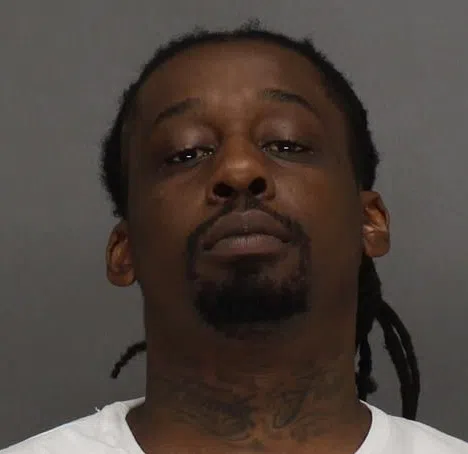
Brown County drug trafficking suspect James Grandberry. (Photo source: Brown County Jail)
GREEN BAY, WI (WTAQ-WLUK) — After James Grandberry, a suspect in a major Chicago-to-Green Bay drug ring investigation, sat in jail for more than 14 months without an attorney or a preliminary hearing — which are usually held within 10 days — the charges against him should be dismissed, and the courts should create a rule that would have suspects be released on bond while the search for an attorney continues, according to his appeal filed Wednesday.
Grandberry, 36, faces 14 charges, including three of manufacture or delivery of fentanyl, amphetamines and cocaine. He was arrested July 11, 2024, and charged about two weeks later. Prosecutors have said this case was the state’s first wiretap investigation for fentanyl and at least 47 people are facing charges.
Grandberry has pleaded not guilty, but no trial date has been set. He returns to court April 10 for a status conference.
While he was waiting for an attorney, Grandberry’s preliminary hearing was postponed 10 times. A preliminary hearing is an early step in the criminal process, at which time prosecutors have to show there is enough evidence for the case to proceed. For those in custody — as Grandberry is, being held on a $1 million cash bond — such hearings are supposed to take place within 10 days.
Grandberry’s motion to have his case dismissed was denied by a judge. Grandberry then filed what’s known as an “interlocutory appeal” asking a higher court for the case to dismissed, arguing his Sixth Amendment rights were violated by the delay. Usually, the appeals court take up issues of law after a case has been completed, but his mechanism allows for an appeal while the case is still pending.
In August, the Court of Appeals said it would hear the case. This appeal case continues, even though an attorney was eventually found for Grandberry and his case is now underway. The filing Wednesday by attorney Joseph Bugni is Grandberry’s first explanation of his arguments in the appeals case.
The 40-page document builds its case off that of Nhia Lee. In that case, the courts ruled Lee’s rights had been violated because he was jailed 113 days without a preliminary hearing. Eventually, the original case was dismissed and prosecutors were allowed to refile the charges.
In the Lee case, the appeals court instructed the circuit courts to use a five-pronged approach to determine if it’s appropriate to postpone a preliminary hearing:
- Whether and why an attorney has not been appointed by State Public Defender,
- Other means of appointing an attorney and whether they have been explored,
- The cost to the community of incarcerating the defendant,
- The prejudice to the defendant
- The special circumstances of the defendant
Grandberry’s appeal argues that Brown County court commissioners and judges inappropriately only looked at the first factor and ignored the other four.
“The question is whether the lower court’s repeated findings met that bar. As set out above, none of lower court’s findings even flirt with Lee’s demands. Instead, at each hearing, the court (whether by Commissioner or Circuit Judge) simply reasoned: Grandberry wants an attorney, there are no attorneys, that’s good cause to waive the time limits. But again, this Court has been clear: “simply observing that the defendant has not yet had counsel appointed by the SPD is insufficient to demonstrate a reasonable inquiry and examination of the facts… The lower court’s failure to abide by this Court’s demands leaves the question of remedy. In Lee, this Court was clear: “the court should have dismissed the complaint against Lee without prejudice based solely on the failure to properly find good cause to delay the preliminary hearing. We therefore reverse the order and remand with directions for it to do so.” That is, at the very least, this case should be reversed and remanded with instructions to dismiss the complaint,” Bugni wrote.
The remedy, according to the Lee case, is dismissing the charges and letting prosecutors re-file them. But Grandberry argues that case didn’t go far enough — and because in cases such as Grandberry’s, the five-pronged review isn’t being followed — the courts should create a rule mandating that if a defendant doesn’t have an attorney, they should be released after seven days. That’s something Oregon and Massachusetts have done, the appeal states.
“While the State may argue that this isn’t feasible, it’s important to keep in mind that administrative burdens aren’t a justification for violating constitutional rights. And a rule of this nature helps balance the competing interests of the State and the defendant, and it also accords with the presumption that people should be released on bond,” Bugni wrote.
The courts should also be more proactive in appointing attorneys, he argues.
“(The court) should have opened up the Brown County bar book and given a call to Green Bay’s top firm and told them they had a new client. And with that, the Court would note that it looks forward to the firm’s commitment to excellence being repeated for James Grandberry. That type of conscription has been done, and is within the circuit court’s power. It’s a necessary power, meant not only to fulfill the constitutional rights of a defendant, but it is also meant to “serve the interests of the circuit court.” The court has an interest in both seeing the Constitution upheld and maintaining an efficient docket,” the appeal states.
The appeal also notes Grandberry wasn’t provided a copy of his criminal complaint for more than a year, adding to his inability to defend himself.
Grandberry’s case is reminder that everyone’s rights should be protected, Bugni wrote.
“In all the discussion of duties and delays, rights and rules, this point can never be lost: James Grandberry is a person—a person cloaked in the presumption of innocence and assured of certain inalienable rights. Despite these irrefutable truths, he sat in jail for well over a year without ever knowing the allegations against him, pleading for an attorney to help him—an attorney that the Sixth Amendment promised him. It would shock any ordinary person’s conscience to know that this happened to someone—too many “someones.” The public rightly expects that the State will honor a person’s constitutional rights—that what’s promised by the Constitution will be fulfilled by the State. But familiarity with delay has (in some corners of the system) bred tolerance for postponement—even indifference for timely enforcing defendants’ rights. This Court’s decision in Lee was intended to provide a wake-up call: a clear warning against rote, unexamined “good cause” findings for putting off the preliminary hearing and perpetuating an endless cycle of delay. The lower court missed the memo. This case provides the ideal vehicle to not only reaffirm Lee, but to give it teeth. Thus, on behalf of James Grandberry—and every person sitting in jail, endlessly waiting for what the Constitution promises them—the defense respectfully asks that the lower court be reversed and this case be remanded with instructions,” the motion argues.
Because of the issues involved and remedies requested, Bugni requested oral arguments with the appeals judges. While oral arguments are permissible, the majority of appeals cases are decided on written briefs.
Prosecutors have not replied to the motion, and no hearings have been granted or scheduled.
Grandberry’s case isn’t the only one to challenge the delays in appointing attorneys. In 2022, eight current and former inmates filed suit in Brown County, seeking an order demanding quicker appointment of counsel. A written decision on that case could be issued in a few weeks.



Comments