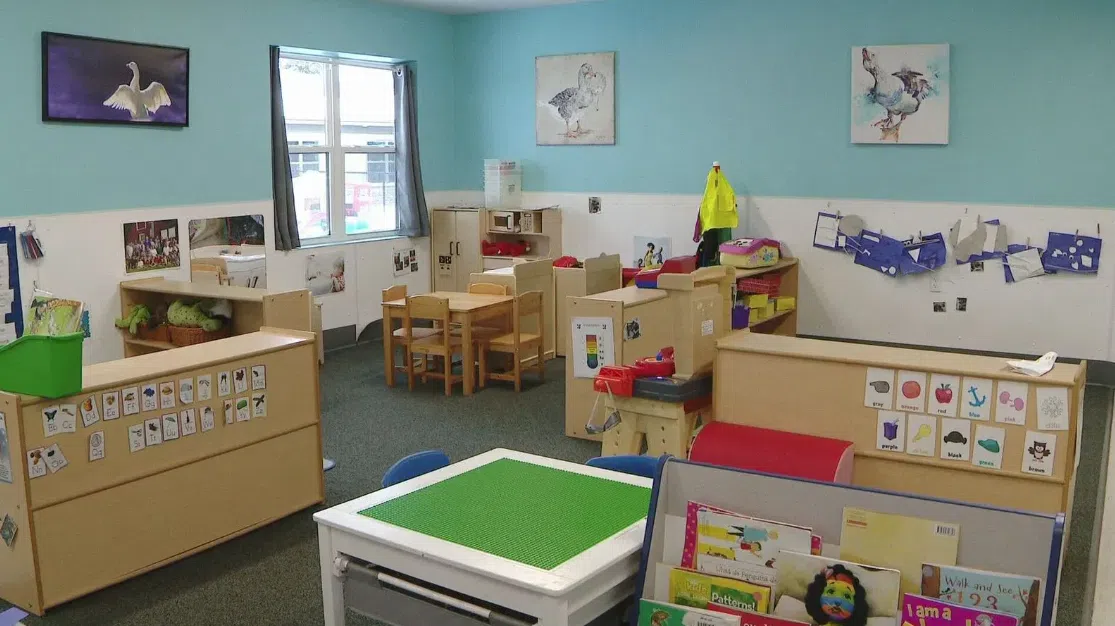
Childcare. PC: Fox 11 Online
(WTAQ-WLUK) — President Donald Trump froze funds to five states amid concerns over child care welfare fraud, and the U.S. Department of Health and Human Services announced states are required to make additional checks in order to receive funding.
Wisconsin is not among the states impacted by the freeze, and the additional checks are already in place in Wisconsin.
How much funding does Wisconsin receive?
There are two main federal funding sources: Child Care and Development Fund (CCDF) and Temporary Assistance for Needy Families (TANF). Both funnel into the Wisconsin Shares program.
- Wisconsin Shares program spent about $424 million over the past year on child care, serving about 36,000 children per month
- The vast majority of the funds come from the federal government. The money is given to the state and administered by the counties. Of course, all money is ultimately derived from taxpayers.
- Gov. Tony Evers’ 2025-27 biennial budget invested over $360 million in child care across two years, including $110 million in grants to child care centers from July 2025 through June 2026. This is called the Wisconsin Child Care Bridge program.
Who is eligible to receive assistance?
To be eligible, a family’s monthly gross income must not be more than 200% of the Federal Poverty Level (FPL). The family stays eligible until their income reaches 85% of the state median income (SMI).
- Family of 2: $3,525 FPL; $5,671 SMI
- Family of 3: $4,442 FPL; $7,005 SMI
- Family of 4: $5,358 FPL; $8,340 SMI
- Family of 5: $6,275 FPL; $9,674 SMI
- Family of 6: $7,192 FPL; $11,008 SMI
Parents or caregivers must be participating in full-time, part-time or contract employment; or be attending basic education or college courses; or be completing high school or an equivalency program (only if under 20 years old); or another activity assigned and approved by a Wisconsin Works or FoodShare Employment and Training agency. It’s designed for the parents to contribute to the economy while raising children.
“We know that it is basic infrastructure in our state for our economy to function, period,” said Ruth Schmidt, executive director of the Wisconsin Early Childhood Association, a child care funding advocate.
Wisconsin Share does not cover the full price of attendance.
Process:
- Parents apply
- If accepted, parents receive a card with pre-loaded funds only eligible to be used at daycare centers
- Parents use card to pay child care centers at the beginning of each month
The Wisconsin Department of Children and Families (DCF) told said that going through the parents makes fraud less likely, as parents create another layer for fraud to need to go through.
DCF provided this statement on the ongoing child care fraud investigations:
The Wisconsin Shares child care subsidy program continues to serve Wisconsin families accessing quality early care and education. January benefits were loaded onto parents’ MyWIChildCare EBT cards on January 1, and families should use the benefits as usual to pay their authorized child care provider.
We are aware of public reporting indicating the federal government has attempted to freeze certain child care funding for several states, reportedly including Illinois, Minnesota, California, Colorado, and New York. At this time, we do not believe Wisconsin programs are impacted by this freeze, however, the Wisconsin Department of Children and Families (DCF) continues to monitor this situation closely and we will review any guidance from the federal government for potential impacts and share information as it becomes available.
How do child care centers report?
Child care centers are required to report full-time enrollment, staffing ratios and verified attendance records regularly. They are also subject to one or more unannounced checks by the Department of Children and Families each year.
Child care centers are required to:
- Report full-time enrollment
- Report staffing ratios
- Report verified attendance records
- Cooperate with one or more unannounced checks by the DCF each year
“We don’t ever get a notification of when they’re coming, but then also, if there’s ever an incident or something like that, they’ll also be coming within around two weeks of that,” said Jordan Hodkiewicz, human resources director for the Appleton-area Play & Grow Learning Center. Hodkiewicz said the three centers are each checked about four times per year by the DCF.
Hodkiewicz said he’s not worried about the potential of additional requirements discussed by the U.S. Health & Human Services — like attendance checks, photo verification, etc. — since Wisconsin already has strict measures in place. Because Wisconsin already has these checks in place, child care funding should be unaffected.
History of fraud in Wisconsin
Wisconsin made sweeping reforms after extensive reports in 2009 from the Milwaukee Journal Sentinel revealed widespread child care fraud in Wisconsin, mostly in Milwaukee. The Department of Children and Families, which oversees the child care welfare program, is required to report any suspended child care providers.
Reports found that family members were receiving money to watch each other’s kids or day cares were staffed almost exclusively with parents of the children in the daycares. Since then, additional regulations have been put in place.
“I would suspect Wisconsin is in a really strong position right now in terms of any potential threats of fraud,” said Schmidt. “I think we have done a lot in the past 15 years to address that and ensure deep accountability… There will be fraud because fraud happens in every system, every possible type of system, but Wisconsin has a lot of effective mechanisms in place to ensure that it is minor, if it happens at all.”
The department suspended 34 child care provider licenses in 2025, mostly in Milwaukee County, but including one in Fond du Lac County and one in Sheboygan County.
Other state funds for child care providers
The $110 million in grants through the Wisconsin Child Care Bridge program are also designed to help recruit and retain qualified staff and provide care for children. Over 100 providers across Outagamie, Winnebago and Calumet counties received funding in the first round of grants alone last July, including Play & Grow Learning Center. The funding ends next June.




Comments