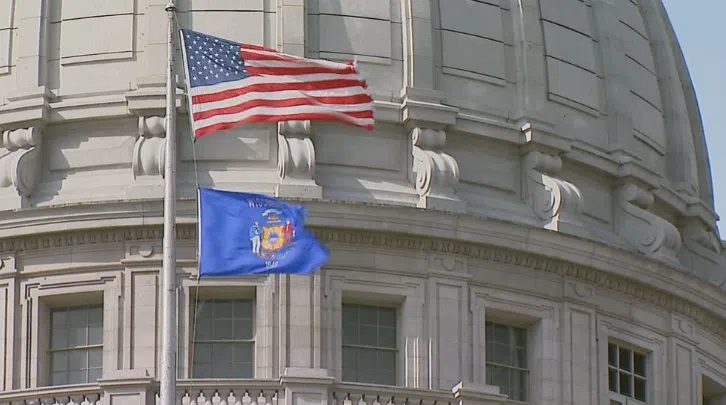
Wisconsin state capital in Madison. PC: Fox 11 Online
(WTAQ-WLUK) — After 18 years, Wisconsin Eye, a non-profit public broadcaster, ceased operations after a lapse in private funding.
“There’s a Joni Mitchell song. ‘You don’t know what you got ’till it’s gone.’ I think that’s what people are experiencing,” Wisconsin Freedom of Information Council President Bill Lueders said.
The online video stream kept the people of Wisconsin, journalists and even lawmakers in the know with unedited coverage of public hearings, legislative floor sessions among other state capitol business.
“I think that the loss of Wisconsin Eye would be a real blow to a functioning democracy in the state of Wisconsin. We’ve come to rely on it for so much in terms of our coverage of our government and that function has to be preserved,” Lueders said.
Lueders is one of the many people who used Wisconsin Eye to cover the capitol and believes the service gave the public a clear look at government functionality.
WisEye.org’s live feed and archives went offline December 15.
It needed $1 million to continue operations.
Now, legislation is circulating to create a new state-run organization that would replace Wisconsin Eye.
“I don’t want to be dependent on a private organization that can go dark or threaten to go dark if they don’t get public money. If we’re going to put in public money, let’s make sure that this is actually streaming every single state government meeting and always on the air,” State Sen. Mark Spreitzer, D, Beloit said.
Spreitzer proposed the idea along with other state democrats including Sen. Kelda Roys, Madison, Sen. Chris Larson, Milwaukee and Rep. Brienne Brown, Whitewater.
The network would remain non-partisan and be funded through general purpose tax dollars.
The bill asks for $2 million in its first year.
The goal is also to retain WisEye’s archived footage.
However, WisEye President and CEO Jon Henkes says the alternative plan is not feasible.
Henkes sent a statement that reads in part:
“The Brown, et. al plan is harming current efforts to raise private dollars sufficient to get the network operational once again in January. It creates doubt among donors; it is a plan that is gaining headlines but going nowhere.”
According to Wisconsin Public Radio, $10 million dollars in state funding for WisEye is available, but isn’t accessible without dollar-for-dollar matching funds.
Henkes said he’s working with leadership to revive WisEye.
Discussions include removing the match requirement, distributing $900,000 to meet WisEye’s 2026 operating budget and for the state to invest remaining dollars.
Spreitzer hopes the bill gets a committee hearing in January.
He’s also open to alternative ideas from Republicans.




Comments