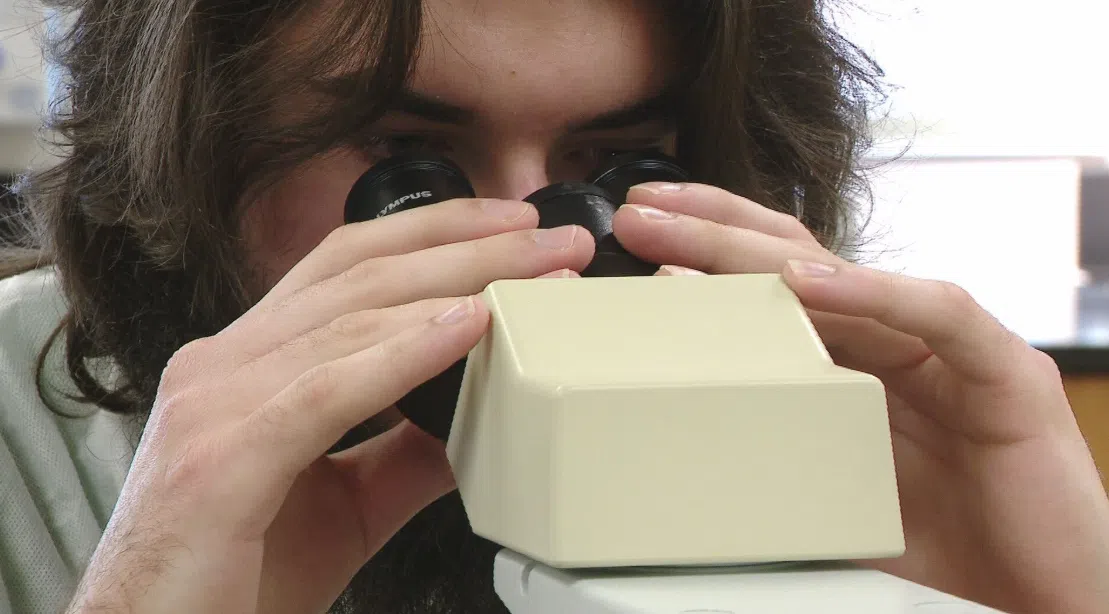
GREEN BAY, WI (WTAQ-WLUK) — It may not look like it, but what’s inside some petri dishes at NWTC could play a part in combating a global crisis.
“Which is the crisis of antibiotic resistance,” says Professor Angelo Kolokithas, the director of biology at NWTC. “What we’re finding in the clinic is that people are getting infections that are not curable by any antibiotic.”
This year marks the eighth year of Kolokithas’ students being involved in the Tiny Earth project — a network with students and universities across the globe, all of them working to reverse antibiotic resistance. For these students, it all starts with collecting a soil sample.
“I personally collected mine from a near-transformer site, which I thought was pretty cool,” says fourth-year student Charlz Nash.
After that, they run test after test after test on their sample.
“[The tests] will help us find out exactly what can and can’t work against this bacteria. Whether or not it’s producing something that could kill other bacteria, which is the main point of what we’re trying to find. And whether or not it can actually be harmful to people as well,” Nash explains.
Simply put, they’re seeing if their bacteria sample is producing new antibiotics — ones that can then be identified, isolated and most critically, tested against human cells to determine if they can fight illnesses.
“I think my favorite part was probably doing the biochemical tests and narrowing down the type of bacteria we had,” Nash shares.
The worldwide program has yielded eight new antibiotics that are in the final phases of clinical trials, according to Kolokithas. And new antibiotics are vital, as the World Health Organization says one in six lab-confirmed bacterial infections are resistant to current antibiotics.
Next week, students like Nash will present their findings to other students and researchers at a Tiny Earth conference at Lambeau Field.
The conference is also open to the public, and Kolokithas encourages people to attend — especially since the public plays a vital role in reversing the antibiotic resistance problem.
“We’re hoping to try to also educate the community on the process of when people don’t take all of their antibiotics fully, what actually happens. How bacteria mutate, and why that’s a problem — where if we don’t finish all of our antibiotics, it might be that they never work for you again,” Kolokithas explains. “We’re trying to make sure that the population is educated to make sure that we can try to slow down this problem.”
If you’ve ever been prescribed an antibiotic, that’s why your doctor says it’s important to complete the entire dosage, even if you’re feeling better after a few days.
Even after students graduate, Kolokithas says their work is uploaded into the Tiny Earth Database, so they can track the progress of their antibiotic.
“So, they get to see each step as it goes, and so they can follow it way into the future and say, ‘Hey, that was the difference I made,” he says.
The Tiny Earth conference at Lambeau Field will be held at 4:30 p.m. Wednesday.



Comments