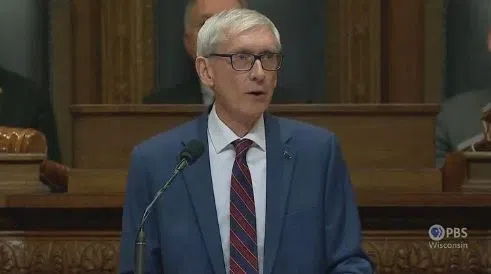
PHOTO: Courtesy of WLUK
(WTAQ-WLUK) — Governor Tony Evers signed eight bills and vetoed a child care tax credit expansion Friday.
The bills signed by the governor include updates to the state’s “Safe Haven” law, expanding professional development opportunities for science teachers, and clarifying which medical and healthcare providers may provide a written note to excuse a child from school, among others.
Gov. Evers vetoed Senate Bill 291 which aims to expand the eligibility of certain child care expenditures for the business development tax credit.
Currently, businesses can receive a refundable tax credit of up to 15% for capital investments in establishing employee child care programs. The bill’s proposed changes would have allowed businesses to claim credits for a broader range of costs associated with providing child care services, including operational expenses, reimbursements to employees for child care, and contributions to dependent care flexible spending accounts.
“While this bill would expand the Business Development Tax Credit to allow businesses and nonprofits to claim up to 15% of the total costs incurred to provide child care services to employees, the bill contains a “catch all” provision that allows businesses to claim the tax credit for “any other cost or expense incurred due to a benefit provided by an employer to facilitate the provision or utilization by employees of child care services,” Gov. Evers wrote. “I am vetoing this bill in its entirety because I object to the Legislature making drastic and vague expansions to tax incentive programs without providing the necessary funding for proper implementation and the clarity necessary to prevent fraud, waste and abuse.”
Meanwhile, the governor signed eight bills including:
Assembly Bill 237, now 2025 Wisconsin Act 94:
- Increases the time within which a parent can relinquish their infant under the Safe Haven law from 72 hours after the child’s birth to 30 days;
- Adds that if the person to whom the infant is surrendered has reason to believe the infant is Native American, then one of the people who can be informed of confidential information about the infant would be a Tribal agent of the infant’s Tribe;
- Requires materials to be developed to ensure parents are informed of their rights, thereby giving them sufficient time to understand their circumstances and make the best decision for themselves and their infant;
- Requires the Wisconsin Department of Children and Families to consult with Native Nations in developing the materials described above; and
- Clarifies that the laws pertaining to child welfare and custody proceedings for Native American children also apply to any Native American child who is relinquished under the Safe Haven law.
Assembly Bill 592, now 2025 Wisconsin Act 95:
- Creates non-statutory provisions that require the Wisconsin Department of Public Instruction (DPI) to work with nonprofit organizations to provide professional development opportunities to science teachers in Wisconsin of students in grades kindergarten to 12 in fiscal years 2025-26 and 2026-27, if funding is supplemented by the Joint Committee on Finance;
- Requires the department to submit a report to the chief clerks of the Assembly and the Senate by Oct. 1, 2027, that describes the number of individuals who received professional development, the science equipment distributed, and each organization that provided professional development opportunities under the program; and
- Requires DPI to request a supplement from the Joint Committee on Finance within 45 days of the bill becoming law, but exempts DPI from the bill’s requirements if the committee does not supplement funding by June 1, 2026.
Senate Bill 259, now 2025 Wisconsin Act 96:
- Requires that the U.S. Department of Defense be notified when a child welfare agency initiates an investigation of abuse or neglect for a child of a member of the U.S. Armed Forces.
Senate Bill 537, now 2025 Wisconsin Act 97:
- Extends current prohibitions and penalties of a fine of not more than $5,000 or a year in jail or both relating to the sale, installation, reinstallation, or distribution of a previously deployed airbag or concealing a missing or previously deployed airbag; and
- Establishes similar prohibitions relating to nonfunctional and counterfeit airbags and imposes additional penalties if bodily harm or death is caused.
Senate Bill 620, now 2025 Wisconsin Act 98:
- Requires the Wisconsin Department of Corrections to track a person convicted of certain sex offenses if the individual is unable to provide an address.
Senate Bill 678, now 2025 Wisconsin Act 99:
- Allows law enforcement to use a person’s oral fluids to conduct a preliminary screening of a motor vehicle, all-terrain or utility-terrain vehicle, off-highway motorcycle, motorboat, or snowmobile while intoxicated; and
- Provides that the law enforcement officer may only collect and retain a person’s oral fluids to the extent necessary to perform the preliminary screening, the officer may not collect or retain it for any other purpose, and the sample must be destroyed or returned after conducting the preliminary test.
Senate Bill 692, now 2025 Wisconsin Act 100:
- Creates separate, graduated penalties related to the manufacture, distribution, or delivery of the synthetic opioid carfentanil, depending on the amount;
- Adds carfentanil to the list of controlled substances for which the five-year penalty enhancer for certain drug offenses near certain places would apply; and
- Adds carfentanil to the list of substances whose weights are determined by including any controlled substance analog of the substance together with any compound, mixture, diluent, plant material, or other substance mixed with it.
Senate Bill 920, now 2025 Wisconsin Act 101:
- Removes registered nurses from the list of healthcare providers that can provide a written statement excusing a child from school.



Comments