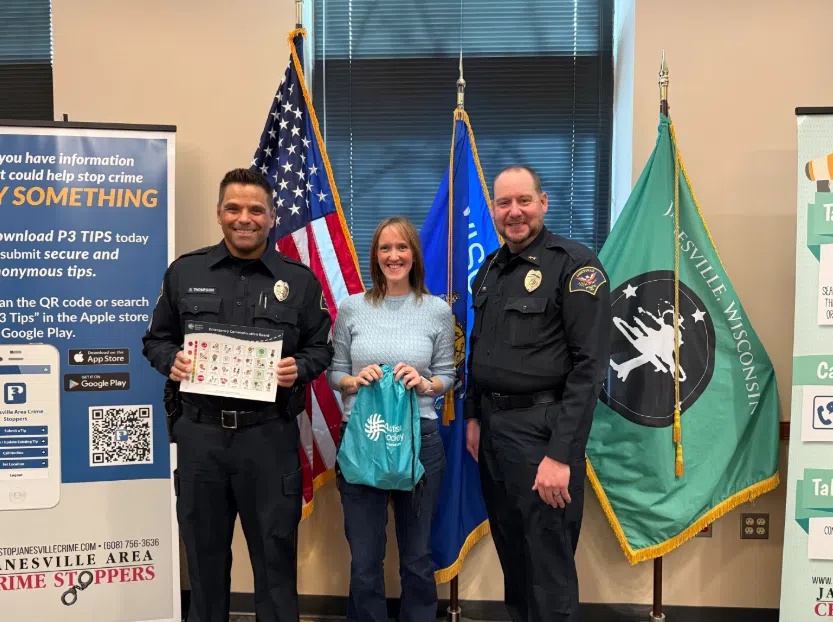
Megan Hufton after 'Safety on the Spectrum' training with officers, (Photo Courtesy: Autism Society of Wisconsin)
GREEN BAY, WI (WTAQ-WLUK) — A new autism-informed training program is available for law enforcement agencies in Northeast Wisconsin.
It’s being brought to our area after the creation of the Autism Society of Wisconsin.
“Safety on the Spectrum” training has been offered in the southern part of Wisconsin since 2024. Now, officers serving Northeast Wisconsin can take advantage.
“We really want to make sure that these interactions are safe and respectful, so that all parties involved are walking away with a good understanding and a good feeling about how that encounter went,” said Megan Hufton, director of community education and training for the Autism Society of Wisconsin.
The training was designed by a task force made up of law enforcement officers, first responders, autistic individuals, parents of autistic children and service providers.
“This truly was designed not just for law enforcement, but with law enforcement,” said Hufton.
John Wallschlaeger was an officer for 22 years and still works as a trainer in crisis intervention and de-escalation.
“There’s no limit to the types of interactions that law enforcement has,” he said. “So that’s why the training became so important.”
According to the Autism Society of Wisconsin, every person’s experience with autism is different, but there are common traits.
Both children and adults with autism may have difficulties with social interactions or communicating. Children may have sensitivity to light and sound. Adults with autism may also experience unusual responses to certain stimuli.
It’s one thing to hear from law enforcement or the Autism Society of Wisconsin. It’s another to hear from the parent of a four-year-old living on the spectrum.
“Day-to-day, our biggest concerns with my daughter, specifically, are communication. So, she has a really hard time communicating her wants, needs, feelings effectively with others, especially strangers,” said Stephanie Cash.
Although Cash’s daughter is just four years old, she knows interactions with law enforcement could come in the future.
“I just worry for her and her struggles with communication that, you know, someone who doesn’t know her won’t realize that her intentions maybe aren’t negative,” she said.
Hufton says she’s had conversations with law enforcement departments in Northeast Wisconsin, but none of them are part of the more than 20 departments she’s done training for just yet.
In addition to trainings, some police departments in southern Wisconsin, like the Middleton Police Department, keep an autism and special needs registry.
“This information provided can expedite the search for a wandering individual by reducing the amount of information collection necessary after a call for service, enhancing immediate efforts and providing a basis from which additional information can be gathered to further tailor the search,” the department said. “In addition, the information assists officers by preparing them to respectfully and appropriately interact with the individual once they have been located.”
Lt. Steve Ziegler from the Middleton Police Department said he would recommend the registry to any department, calling it “another way to improve relations with the community and prevent misunderstandings.”




Comments