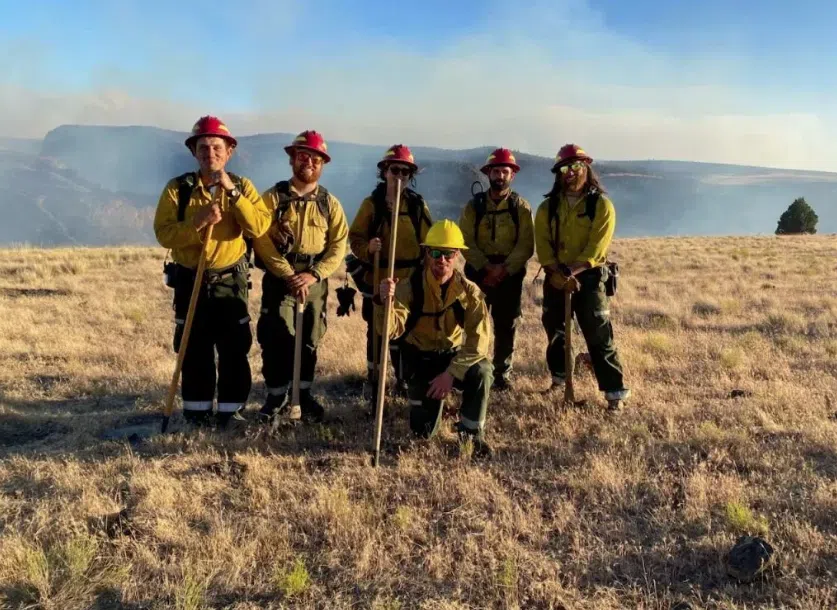
Wisconsin DNR forestry technician, Aidan Rettler (second from left) was part of a team from Wisconsin deployed to the western part of the U.S. to help fight wildfires. (Courtesy: Aidan Rettler)
(WTAQ-WLUK) — We’re past the peak of wildland fire season in Wisconsin, and now, the state’s Department of Natural Resources is helping others.
Nearly two dozen Wisconsin DNR staff members are fighting fires in the western U.S. and Canada.
Close to 70 active large-scale wildfires are burning over a million acres in the United States alone. Much of this wildfire activity is occurring in Alaska, Washington, Oregon, Idaho, Nevada, Arizona and California and is related to dry lightning strikes in dense wooded areas with remote access.
Wisconsin DNR forestry technician Aidan Rettler was part of a team of Wisconsinites who went to Oregon to help fight the Cram Fire, in the central part of the state. Rettler recently returned to his home post at the Oconto Falls Ranger Station from a three-week assignment.
“It can be daunting out there. Those fires move a lot quicker. They’re very terrain-driven, which means those fires run up hills quickly, their fuels are a lot drier,” he said. “We worked 16-hour days, so you work 16 hours, you get eight hours off. And those eight hours, you’re usually out in a fire camp. You’re sleeping on the ground.”
The more than 95,000-acre wildfire Rettler worked on is now 100% contained.
“Whenever a new fire would start, we’d typically be some of the first people to get to the fire, along with local resources. We would begin initial attack, which is the first phase of fighting the wildfire, and as other resources could come in, we’d take a step back and prepare ourselves for the next new fire,” said Rettler about the work he did out west.
Wisconsin currently has about 20 DNR firefighters battling blazes in the western U.S. and Canada. State officials assess local needs before sending resources out of state.
In addition to manpower, several engines and other equipment are deployed too. It’s work and equipment that is loaned out every summer as part of regional and national mutual aid agreements.
“Wisconsin is part of the Great Lakes Forest Fire Compact, which includes Minnesota, Wisconsin, Michigan and also the provinces of Ontario and Manitoba. Our federal master agreement is what we utilize to send resources outside of that five state compact,” said forester Jim Kujala, who helps to organize the Wisconsin volunteers.
While conditions and terrain out west are much different than Wisconsin, the skills the firefighters are learning and using will translate well once they’re back home.
“I’d do it in a heartbeat. It helps me become a better firefighter. Helps me be more prepared for Wisconsin fires and serve Wisconsin when the time comes,” added Rettler.
The Wisconsin firefighters and engines are slated to be on assignment for two weeks, or until the fire severity subsides. The DNR anticipates additional mobilizations over the coming weeks, as the western fire situation increases and local resources are depleted.
Three wildland fire engines are currently stationed in Oregon, as part of a larger task force responding to various longer-duration fires, allowing local resources to focus on responding to emerging fires. Six DNR staff are in northern Manitoba, serving in overhead support roles, as well as a few assigned to a multi-state agency hand crew. Another DNR engine is responding to fires in northern California.
A newly formalized and nationally accredited Wisconsin DNR Incident Management Team (IMT Type 3) is also on standby for western fire support. The team has 10 positions and can be mobilized to assist a local agency.
Wisconsin has mobilized more than 65 firefighters to out-of-state fire assignments so far in 2025. DNR staff were mobilized to 12 different states and provinces, including 20 individuals supporting the ongoing suppression efforts in Canada.




Comments