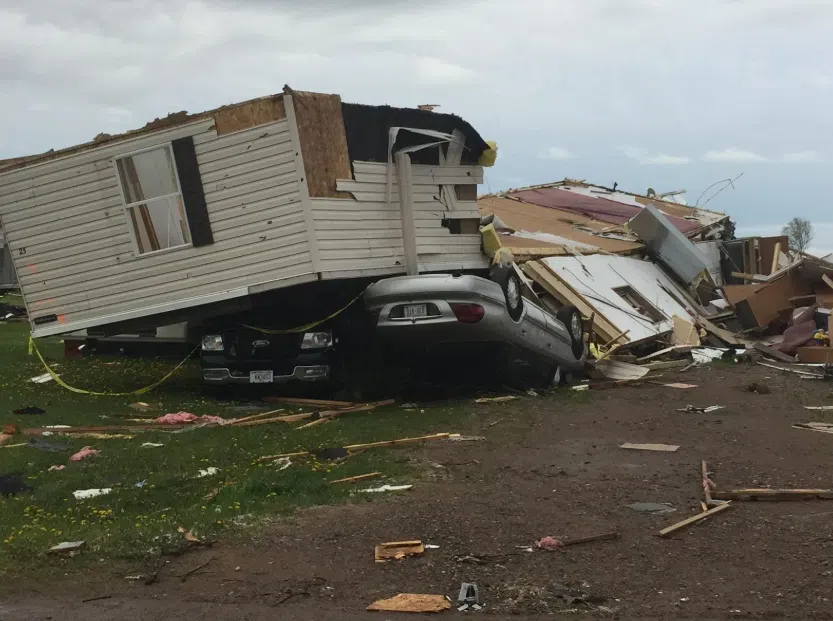
Tornado damage at Prairie Lake Estates in Chetek, May 17, 2017. PC: Fox 11 Online
(WTAQ-WLUK) — As severe weather season looms, residents of manufactured or “mobile” homes face unique challenges in finding safe shelter.
Paula Van De Leygraaf, Outagamie County Emergency Management director, emphasized the lack of safe options for those in mobile or manufactured homes during tornadoes.
“Being in a mobile home or a manufactured home during a tornado, there’s just no safe place for people to go,” she said.
Manufactured homes, regulated by the U.S. Department of Housing and Urban Development since 1976, are built to withstand winds up to 70 miles per hour under Wind Zone One standards. However, even the weakest tornadoes, classified as EF0, can produce winds between 65 and 85 miles per hour, posing a significant threat to these structures.
Dan Kane, Brown County Emergency Management director, highlighted those dangers, noting that “about 72% of deaths occur in homes, regardless of type of home, and 54% of those deaths were in mobile homes, even though mobile homes made-up only about 6% of the total population of homes in the country.”
In May 2000, a brief EF0 tornado and straight-line winds caused severe damage in St. Nazianz in Manitowoc County, overturning most of the homes in a mobile home park.
Emergency management officials in Brown and Outagamie counties stress the importance of planning ahead. Kane advised residents to seek shelter with family or friends or to inquire about publicly-owned properties that may offer refuge.
“If you have family, friends, relatives that you can stay with, I would recommend checking with those,” he said.
Van De Leygraaf urged residents to prepare during “blue sky days” by identifying safe places to go if their home is not secure.
“Have your plan, and in your plan, identify if you are at home and you don’t have a safe place to go. Identify those places,” she said.
Apartments, while less vulnerable than manufactured homes, still require a safety plan, especially for those on higher floors. Last May, an EF1 tornado in Kaukauna damaged a senior apartment building, underscoring the need for preparedness.
Van De Leygraaf noted that landlords are not required to provide storm shelters, stating, “They just have to provide a safe place for people to live. But that does not include safety during a storm.”
The Kaukauna tornado caused damage across town, including tearing off a portion of the roof on the senior apartment building.
For all housing types, the safest option is a designated tornado shelter. However, neither Brown nor Outagamie county has FEMA-certified storm shelters due to funding limitations.
Kane acknowledged the need for such facilities, saying, “There just hasn’t been a real ability to get these types of grants and programs here. But needless to say, I do think there is a need, and I think it’s something we’re always looking at in emergency management.”
Residents planning to use public facilities as shelters should verify their availability in advance, as policies vary by municipality. Options may include fire stations, libraries or village halls.




Comments