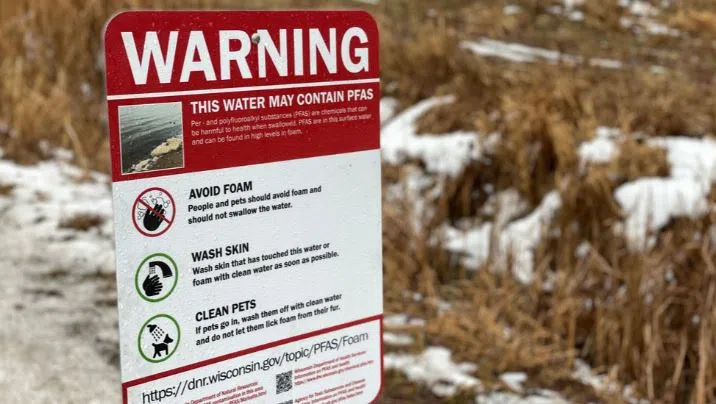
PFAS Advisory Sign, January 4, 2023. PC: Fox 11 Online
MARINETTE, WI (WTAQ-WLUK) – Governor Tony Evers is trying to expand his safe drinking water initiative by including funding and measures to combat PFAS in his upcoming biennial budget. The governor discussing his plans during several visits across the state today, including one in Marinette.
Whether it’s kids in the classroom, families at home, or our farmers and agricultural industries, Wisconsinites’ health and well-being depend on access to clean, safe water. Folks should be able to trust that the water coming from their tap is safe, but we know that’s not the case for far too many families and communities,” said Gov. Evers. “We have a responsibility to ensure Wisconsinites have access to safe, clean drinking water no matter where they live in our state. This is an urgent issue, and we cannot afford more years of inaction and obstruction. I urge Republicans and Democrats to work together to do what’s best for our kids and Wisconsin’s families by investing in critical efforts to improve water quality and get contaminants out of our water in our next state budget.
But the proposal is not sitting well with everyone.
“Water doesn’t discriminate,” said Cindy Boyle from the Town of Peshtigo. She’s just one of the dozens of Marinette County residents who lives in the Tyco/Johnson Controls PFAS contamination plume.
She said, “It is a constant state of toxic awareness. Quite literally people who have it in their drinking wells are consuming it and then you have health effects which I and my family have.”
For the last seven and a half years Boyle has been on the frontlines of the PFAS battle, not only trying to protect her family, but other property owners too. “We have an identified responsible party so they are putting filtration systems on our homes so at least I can sleep at night,” she added.
On Tuesday, Boyle joined other Marinette County residents for a roundtable discussion with Governor Tony Evers.
The governor introducing new plans he’s including in his biennial budget, to combat PFAS while also expanding access to clean, safe drinking water statewide.
“There’s enough money in the budget to deal with all sorts of contaminants, not just PFAS. So, that’s the important thing,” said Gov. Evers.
In addition to $145-million investment, earmarked to combat PFAS – the governor wants to expand eligibility for the state’s Well Compensation Program, and he wants to adopt the Chemical Level Enforcement of Remediation or CLEAR Act.
According to Evers, “We’re going to set PFAS standards via law rather than continuing to use the present system to get enough people behind it on the other side, that will be set in this new law.”
Republicans agree the state needs to address PFAS and enhance the drinking water in the state, but they believe the governor is going about it the wrong way.
“If you notice in some of the details, he mentions having it being exempt from the REINS Act. And what the REINS Act does is it requires that any expense over $10 million has to be approved by the legislature. And, by him saying I want this exempt, that’s an oversight exemption the legislature will not be willing to give,” said State Rep. David Steffen (R-Howard).
While Cindy Boyle understand this is a political issue, she doesn’t think it should be on the backs of public health. She added, “If we could get one person from each party, talking about this on the same team, that’s when I’ll be optimistic and we have to do this.”
Senator Eric Wimberger (R-Oconto) released the following statement after Governor Evers announced he would include a series of PFAS remediation initiatives in his upcoming State Budget proposal:
It seems Governor Evers has come around to my position and supports my bill that he vetoed last year. His proposals today are an admission of what I’ve been saying for years: we can’t just write the DNR a check for $125 million to fight this problem. We need a strong legal framework to fight PFAS contamination, including language protecting innocent landowners from being treated like polluters.
However, I’ve been waiting for months for the Governor to clarify his definition of an ‘innocent landowner,’ and he has refused to respond to my requests. This delay is holding up meaningful solutions to PFAS problems affecting communities across our state. I find myself sitting at the table waiting to have a meaningful conversation on how we can pass a bill to fight PFAS in Wisconsin, and I hope the Governor will join us there soon.
Midwest Environmental Advocates Staff Attorney Rob Lee added,
In principle, we would support a narrow exemption that protects farmers, as long as it is paired with adequate funding to remediate contamination resulting from the spreading of contaminated biosolids. Ideally, PFAS polluters would bear the costs of remediation, unlike previous proposals from the legislature, which would have let PFAS polluters off the hook.




Comments